
 Tweet
Tweet
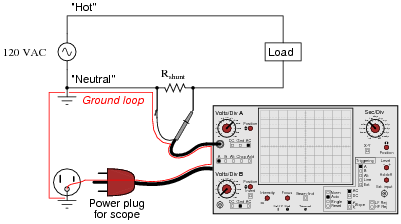


อธิบายไม่เก่ง บอกไปเดี๋ยวยิ่ง"งง"มากกว่าเดิม
ลองดูคำอธิบายจากหลายๆเวปดีกว่า
One of the most commonly-encountered pitfalls is the creation of ground loops in the front-end instrumentation. The presence of ground loops can often be detected by observing a 60 Hz signal or a series of fast pulses (voltage spikes) in the output in sync with the local AC power line. Keep in mind that detection of these line-synched signals may be caused by other problems, however, and they do not necessarily indicate the presence of a ground loop. Ground loops are formed by grounding the front-end electronics at more than one point. Providing this extra ground connection allows current to flow into one grounding point and out of another, traveling through the detector/preamplifier ground connection.
Current can flow around a ground loop for a number of reasons: There may be a radio frequency signal nearby inducing a current in the loop (the loop is effectively a magnetic dipole antenna). Also, there may be electrical equipment nearby drawing current from (and thereby producing small voltage fluctuations in) the local grounds. When these 'ground currents' flow through the grounds of the front-end instrumentation, they can be large enough to produce a small but significant voltage drop across the detector ground connection. In this way the unwanted ground current 'signal' is mixed in with the detector signal. To avoid a ground loop problem, avoid making any extra (perhaps inadvertent) connections to the detector ground. In fact it may be advisable to shield the detector ground if the system is placed in a particularly noisy environment.
The problem and solution are illustrated here

--------------------------------------------------
- เวป Computer Dictionary Definition - ground loop
ground loop
A circular path created between the data lines and the ground wires when electronic devices communicate with each other. When systems have earth grounds through different power sources, differences in reference voltages can cause problems for various reasons

The ground loop is created because all the equipment is wired to earth ground.
inter-system ground noise
Unwanted disturbances in the data lines between two electronic devices communicating with each other due to unbalanced reference voltages in the ground loop. Data signals can be altered, and electronic circuits can be damaged. Causes are poor building grounding at one of the electric panels, power supplies that filter unwanted noise into the ground line (ground noise injection) and voltage surges due to ground faults and lightning strikes.
RS-232 lines, long printer cables and USB cables are subject to inter-system ground noise, while optical fibers and Ethernet are not. There is no electrical current in optical fibers, and Ethernet adapters are electrically isolated from earth ground.
Various causes can create an imbalance in the ground loop. When communications equipment uses earth ground as a voltage reference, the voltage differences can cause signal loss and hardware malfunction.
ground
A reference voltage level of "zero potential" for electric and electronic circuits. For most equipment plugged into an AC outlet, the word ground generally refers to the earth, and the metal parts are grounded ("chassis ground") to the earth for safety. In the case of a short circuit, the current flows through the green wire and third prong in the power cord (U.S. and Canada), which causes the circuit breaker to trip.
Signal Ground
Power supplies, circuit boards and signal pathways in most electronic equipment are also connected to the same earth ground as the chassis for reference voltage and safety. There are exceptions; for example, medical equipment that is attached to a patient is generally isolated from earth ground even when plugged in, because the time between a short circuit and the breaker tripping could prove fatal. Ethernet adapters and other networking equipment are also isolated from earth ground in order to prevent unbalanced ground loops from causing interference (see ground loop).
Portable Devices
Every portable, battery-operated device, such as a laptop and iPod, as well as the electrical systems in every vehicle, have their own zero reference voltage. Naturally, these systems are not connected to earth ground, but the reference voltage is still called ground.
Building Grounds
At the electric panel in U.S. and Canadian buildings, the ground lines are wired to the neutral line of the electric service, to the earth via a ground rod and to the metal plumbing pipes. In large datacenters, a separate ground system may connect every server via heavy-duty cable to the metal structure of the building to ensure that the voltage reference between all equipment is the same.
--------------------------------------------------

Ground loop เป็นปัญหาที่อาจเกิดขึ้นได้ในลูป เป็นลักษณะของการมี Ground เชื่อมกับ Earth มากกว่า 1 จุด Gound จำเป็นในระบบไฟฟ้าและระบบสัญญาณเพื่อเป็นจุด Reference ของทั้งระบบ ถ้าระบบมีการ Ground - Earth มากกว่า 1 จุด แทนที่กระแสจะผ่าน Ground ลง Earth ไปแล้วไปเลย แต่กลับไหลขึ้นมาจาก Earth ไปยัง Ground อีกจุดหนึ่ง ทำให้รับกวนสัญญาณในระบบ บางทีจะเกิดการสปาร์คขึ้นเมื่อเอาสายกราวด์ไปแตะกับจุดลงกราวด์ของอุปกรณ์ Ground loop สามารถทำลายชิ้นส่วนไอซีในอุปกรณ์ได้ และเป็นปัญหาในการสื่อสาร
ในระบบที่เสถียรทั้ง Powe Line และ Signal Line จะต้องมีจุด Reference ground เดียวกัน แต่เมื่อ Ground มีหลายจุดทีี่ต่อกับ Earth มีโอกาสสูงที่ความต่างศักดิ์ของ Ground แต่ละจุดต่างกันทำให้เกิดกระแส Loop เกิดขึ้น
--------------------------------------------------
- เวป ClubJZ Forums - ground loop เกิดจากอะไรครับ
ground loop เกิดจากอะไรครับ
ได้ยินมาว่า .. ถ้าติดตั้ง groundwire ไม่ดี จะเกิด ground loop
" ติดตั้งไม่ดี " หมายถึง อย่างไรครับ ?
หมายถึงมีกราวนด์ 2 เส้นหรือมากกว่า ที่เส้นใดเส้นหนึ่งหรือมากกว่า ต่อไว้ไม่ดีทำให้กระแสไฟไหลไม่สะดวก และเกิดความต่างศักย์ไฟฟ้าขึ้น
เช่น ในรถยนต์เมื่อเอาโวลต์มิเตอร์จับขั้วบวกกับกราวนด์ (ขั้วลบ) จะต้องได้ 12 โวลต์ แต่ถ้ากราวนด์เส้นนั้นมีความต้านทาน จะวัดได้น้อยกว่า 12
ทีนี้ถ้าวัดระหว่างกราวนด์ด้วยกัน จะต้องได้ 0 โวลต์ แต่กราวนด์บางอันที่ไม่ดี กลับมีแรงดัน เช่น 1 โวลต์ แรงดัน 1 โวลต์นั้นก็จะไหลไปในระหว่างกราวนด์ด้วยกันได้
วิธีป้องกันกราวนด์ลูปที่ง่ายที่สุด คือใช้กราวนด์เส้นเดียวครับ
--------------------------------------------------
- เวป Yamaha Professional Audio Products - Grounding Affects Noise & Safety
Improper grounding can create a lethal hazard. Even if you avert danger, ground loops are the most common cause of AC line frequency hum in sound systems. So it pays to learn about grounding, and use what you learn.
What is a Ground Loop?
A ground loop occurs when there is more than one ground connection path between two pieces of equipment. The duplicate ground paths form the equivalent of a loop antenna which very efficiently picks up interference currents. Lead resistance transforms these currents into voltage fluctuations. As a consequence of ground-loop induced voltages, the ground reference in the system is no longer a stable potential, so signals ride on the noise. The noise becomes part of the program signal.
Can ground loops be eliminated?
Even experienced audio engineers may find it difficult to isolate ground loops. Sometimes, in poorly designed sound equipment (which may include expensive sound equipment), ground loops occur inside the chassis even though the equipment has balanced inputs and outputs. In this instance, little can be done to get rid of the hum short of having a skilled audio engineer redesign the ground wiring inside. Yamaha equipment is engineered very carefully with respect to internal grounding.
You should avoid unbalanced equipment in professional sound systems (unless the equipment is all going to be very close together, connected to the same leg of the AC service, and not subject to high hum fields).
In fact, if all connections are balanced and the equipment is properly designed and constructed, external ground loops will not induce noise. Because Yamaha equipment is less susceptible to ground loop problems, you may find it faster and easier to set up than to set up other makes of equipment which outwardly appear to have similar features and specs.

Figure 1 illustrates a typical ground loop situation. Two interconnected pieces of equipment are plugged into grounded AC outlets at separate locations, and signal ground is connected to earth in each of them. The earth ground path and duplicate signal ground path form a loop which can pick up interference. If the equipment is not properly built, these circulating ground loop noise currents (which act like signals) travel along paths not intended to carry signals. The currents, in turn, modulate the potential of the signal-carrying wiring, producing hum and noise voltages that cannot easily be separated from program signals by the affected equipment. The noise is thus amplified along with the program.
What can you do to avoid ground loops?
There are four basic approaches to handling grounds within audio systems: single point, multiple point, floating, and telescoping shield. Each has specific advantages in different types of systems.

Figure 2 illustrates single-point grounding. Chassis ground in each individual component is connected to earth; signal ground is carried between components and connected to earth at one central point. This configuration is very effective in eliminating line frequency hum and switching noise, but is easier to use in permanently installed systems. Single point grounding is popular in recording studio installations. It is also effective in the wiring of individual equipment racks. However, it is almost impossible to implement in complex, portable sound reinforcement systems. We don't recommend using this approach with Yamaha SR gear.

Figure 3 Multiple point grounding is what you find with unbalanced equipment in which the chassis connects to signal ground. It is very simple in practice, but it is not very reliable particularly if the system configuration is changed frequently.
Multiple point ground systems that employ balanced circuits with properly designed equipment present no special noise problems. This approach is fine with most Yamaha equipment.

Figure 4 shows the floating ground principle. Observe that signal ground is completely isolated from earth ground. This scheme is useful when the earth ground carries significant noise. However, it relies on the equipment input stages to reject interference induced in cable shields, so the input amps better be good.

Figure 5 illustrates the principle of telescoping shields. This scheme is very effective in eliminating ground loops. When noise enters a shield connected only to earth, that noise cannot enter the signal path.
Implementing this approach requires balanced lines and transformers since ground is not carried between components.
One drawback is that cables may not all be the same some having shields carried through at both ends, and others not, depending on the equipment so it becomes more complicated to sort out the cabling upon setup and breakdown of a portable system. Here is a summary of the basic rules that guide the choice of grounding schemes:
Identify separate subsystems (or equipment environments) that may be contained in an electrostatic shield that drains to earth.
Connect signal ground within each separatesubsystem to earth at one point only.
Provide maximum isolation in connections between subsystems by using transformer coupled floating balanced connections.
Grounding isn't essential for avoiding noise but safety is another matter!
Equipment does not have to be grounded to prevent noise from entering the system.
The main reason we ground a sound system is for safety; proper grounding can prevent lethal shocks. The next reason for grounding a system that includes AC powered equipment is that, under some conditions, proper grounding may reduce external noise pickup.
While proper grounding doesn't always reduce external noise pickup, improper grounding can increase external noise pickup.
--------------------------------------------------
- เวป wikipedia
In an electrical system, a ground loop usually refers to a current, generally unwanted, in a conductor connecting two points that are supposed to be at the same potential, often ground, but are actually at different potentials. Ground loops created by improperly designed or improperly installed equipment are a major cause of noise and interference in audio and video systems. They can also create an electric shock hazard, since ostensibly "grounded" parts of the equipment, which are often accessible to users, are not at ground potential.
Simplified circuit illustrating a ground loop


Comment