 Tweet
Tweet
 นักวิจัยสิงค์โปร์ใช้เทคโนโลยีของ Intel ทำให้หุ่นยนต์แสดงความรู้สึกได้
The National University of Singapore research team behind the novel robotic system integrated with event-driven artificial skin and vision sensors was led by assistant professor Harold Soh (left) and assistant professor Benjamin Tee (right). With them are team members (second from left to right) Sng Weicong, Tasbolat Taunyazov and See Hian Hian. (Credit: National University of Singapore)
Singapore Researchers Look to Intel Neuromorphic Computing to Help Enable Robots That ‘Feel’
What’s New: Today, two researchers from the National University of Singapore (NUS), who are members of the Intel Neuromorphic Research Community (INRC), presented new findings demonstrating the promise of event-based vision and touch sensing in combination with Intel’s neuromorphic processing for robotics. The work highlights how bringing a sense of touch to robotics can significantly improve capabilities and functionality compared to today’s visual-only systems and how neuromorphic processors can outperform traditional architectures in processing such sensory data.
“This research from National University of Singapore provides a compelling glimpse to the future of robotics where information is both sensed and processed in an event-driven manner combining multiple modalities. The work adds to a growing body of results showing that neuromorphic computing can deliver significant gains in latency and power consumption once the entire system is re-engineered in an event-based paradigm spanning sensors, data formats, algorithms, and hardware architecture.”
— Mike Davies, director of Intel’s Neuromorphic Computing Lab
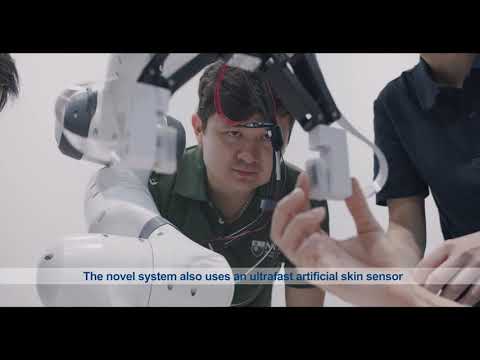
This novel robotic system developed by National University of Singapore researchers comprises an artificial brain system that mimics biological neural networks, which can be run on a power-efficient neuromorphic processor such as Intel’s Loihi chip, and is integrated with artificial skin and vision sensors. (Credit: National University of Singapore)
About the Intel Neuromorphic Research Community: The Intel Neuromorphic Research Community is an ecosystem of academic groups, government labs, research institutions, and companies around the world working with Intel to further neuromorphic computing and develop innovative AI applications. Researchers interested in participating in the INRC and developing for Loihi can visit the Intel Neuromorphic Research Community website. A list of current members can also be found at the site.
More Context: Neuromorphic Computing (Press Kit) | Intel Labs (Press Kit) | How Neuromorphic Computing Uses the Human Brain as a Model (Video) | Exceptional sense of touch for robots and prosthetics (National University of Singapore) | New breakthrough by NUS researchers gives robots intelligent sensing abilities to carry out complex tasks (National University of Singapore)
Tags: Intel Labs, Intel Neuromorphic Research Community, Neuromorphic computing, Robotics, Singapore News


Comment